Weeds have been defined as any plant growing out of place. In reality most compete with our crops for moisture, light and nutrient, make a plot look unkempt and if allowed to seed can be annoying to other plot holders, some also host pests, e.g., whitefly on thistle. On the plus side strong weed growth is often a sign of fertile soil. Weeds will grow irrespective of how a garden or allotment is cultivated and it does take time to keep them under control particularly during the main growing season. How they are controlled is up to the individual and the following are a few notes giving a number of options.
Common annual weeds at Ashbrook such as speedwell, groundsel and chickweed are easy to control by regular hoeing. Weeds such as docks and dandelion form tap roots and are best dug out, if the top is sliced with a hoe the remaining root will regrow. Couch grass and both strains of bindweed produce extensive sub soil roots and are far more difficult to deal with but can be beaten.
The main vegetable growing season (April to mid-July) is very short, during this period crops should be growing well and need your attention, weeds will also be growing strongly but do you really want to spend that time of year on your knees hand weeding or wrestling with couch roots? That is the hard way. How weeds are tackled depends on your style of gardening and current state of your plot. Let us consider a number of scenarios: –
Firstly, let us assume that your plot, is relatively weed free, has been winter dug or rotavated and in the spring is being planted, weeds generally appear before your crops. By far the easiest way to keep such plots weed free is frequent use of a dutch hoe which is used to slice off any weeds at ground level while they are still small. If the ground is drying out fine soil can be used to fill shrinkage cracks and reduce evaporation. The dutch hoe is intended for pushing to and fro on the soil surface to slice no more than the top 3mm of dry ground not for pushing into damp soil.
Another very useful tool that performs a similar job is the Wolf 2 in 1 cultivator. This tool is cleverly designed, on one face is a dutch type hoe that slices off weeds as it is drawn towards you. The opposite face has three reflexing prongs that when pulled towards you is particularly useful for working winter dug ground into planting condition and for incorporating fertiliser such as blood fish and bone into the soil, however don’t use it too close to the roots and foliage of growing crops. This clever design of prongs superior and easier to use than the more traditional three 90-degree prong cultivator which requires more effort. Being a multi tool the 2 in 1 is available with different lengths of handle to suit your own physic. For ground in active cultivation this tool allows large areas to be covered quickly.
When planting it is worth allowing adequate spacing so a hoe can be worked along and between your crops.
Then consider raised beds which once set up requiring minimum digging. At all opportunities, well-rotted compost or manure is used as a mulch to suppress weed growth, the few weeds that do emerge can generally be dealt with by hand. This is a very good method of growing providing the plot is thoroughly cleared of perennial weeds before setting up the beds, also provided there is a plentiful supply of well-rotted material available and provided any perennial weeds that encroach are dealt with promptly.
Certainly, annual weeds can be kept under control by adopting the above methods however perennials will probably still appear and often need different treatment.
In recent years vacant plots have often been largely cleared of heavy weed infestation by the society prior to letting however the roots of couch grass and bindweed range widely run very deep and can still be a thorough nuisance. There are several ways of dealing with them: –
1)The first will take a full growing season.
About mid-April plant potatoes but avoid first or second early varieties and blight prone main crop varieties, none will smother the ground for long enough. Instead use a main crop variety with good blight resistance, weed suppressing foliage and long season of growth such as Sarpo Mira. If your ground is compacted loosen or dig along the row and apply some fertiliser such as blood fish and bone before planting. Keep the plants well earthed up so to disturb weed growth as much as possible.
Lift the crop at the end of September, at the same time remove any surviving couch and bindweed. By the end of September perennial weed growth will slow down however the soil is still be warm and fast-growing annuals such as chickweed and groundsel will probably reappear.
If possible, dig the ground over again between November and January, watch for a weather window, dig in annuals and clear any remaining perennial weed; your ground should then be clean, can be left to weather and will be ready for planting next spring. Regular weed control with a hoe is then easy
The beauty of this method is that you clean your ground and get a crop all in the same year.
2) A second and much quicker option is a glysophate based weed killer such as Roundup where spot weeding is an effective way of removing individual clumps.
3) A third option is a bit of both the first two and is what I did.
My first plot at Ashbrook was only five poles and not large enough for a growing family so about 1993 I moved to my current 10 pole plot. But when digging a few trial holes, I discovered the whole area was heavily infested with both hedge and field bindweed. From previous experience with bindweed, I had found trying to dig out roots that can extend 6’ down was futile.
First the plot was autumn dug and any bindweed roots in the top spit were removed, the far deeper roots however remained.
Then I divided the plot into four quarters and over the next four years rotated 1) brassicas, 2) root crops (carrots, beetroot and parsnips) plus onions, runner beans and courgettes, then 3) potatoes, then 4) shallots and legumes (peas and broad beans).
The quarters with brassicas and root crops gave little opportunity for dealing with bindweed.
However, the quarter with potatoes meant that when earthing and lifting the crop more bindweed roots could be removed thus weakening the weed to that quarter.
However, the quarter with shallots, peas and broad beans was easy. These crops were planted early spring, cropped late June then removed from the ground in July and that quarter of ground was then left clear. The bindweed then appeared in June and July and was allowed to trail extensively over the vacant soil surface. It was then easy to spot weed with a very small amount of glysophate so that by the end of September that quarter was clear. With rotation another quarter would be with cleared the following year and so on. Overall, I found this method slow but very effective.
Sometimes plot holders cover weed infested ground with black polythene, fabric or carpet, this is a temporary measure and rarely works over long periods as: –
- Only one generation of annual weeds is suppressed
- Perennial weeds e.g., bindweed and couch grass continue to thrive in the warm environment below.
- Any light that penetrates laps and edges will continue to allow weed growth.
- Beware modern carpet material does not rot and the society asks you not to use it.
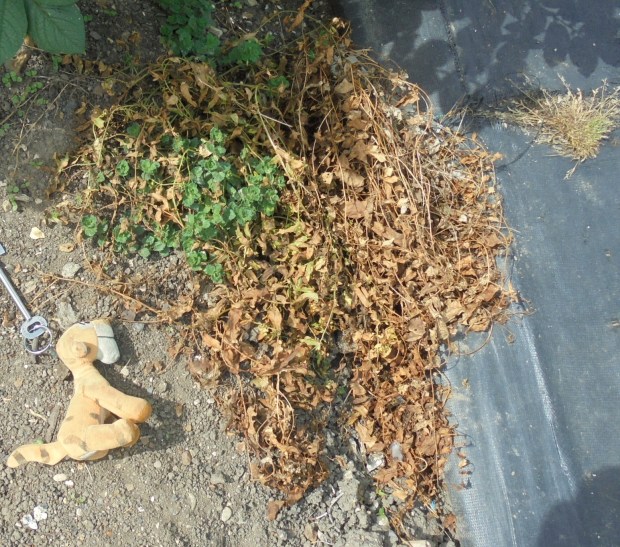
- Covering bare ground during the winter months with fabric can be effective in preventing germination of weeds although this will reduce frost penetration and prevent pest predation by birds.
Beds that have permanent or semi-permanent plantings such as fruit and asparagus etc need particular attention. Obviously ensure ground where such crops are to be grown is clear of perennial weeds before planting, then be diligent about keeping the area weed free
What you do with weeds is an individual choice. I find plastic dalek type bins very good for composting and a combination of shredded crop foliage, kitchen waste, grass cuttings, cardboard and weeds, even chopped up dock and dandelions decompose fairly quickly and all result in good compost for returning to the soil at the end of the year. The exceptions are roots of couch grass and bindweed which are best dried and burnt or disposed of elsewhere. If properly set on chicken wire these compost bins also exclude rats.
Running an allotment requires adequate preparation also doing the right thing at the right time.
If lack of time currently prevents you keeping on top of your current plot it might be worth enquiring about reducing to one of more manageable size. After all a smaller plot well managed is preferable to a large one that appears neglected.
 Ashbrook Allotments