Although onion sets can be planted in the autumn, I find they do not give as good a crop or keep as well as spring plantings. The following notes therefore apply to spring plantings.
When growing spring planted onions it is worth remembering a few of their characteristics.
Firstly, their growth is influenced by day length; they form leaves as the days lengthen and the bulbs swell during July as the days start to shorten.
Secondly, the ultimate size of an onion is determined by the number of leaves it produces, each internal ring represented by a leaf, so the more leaves, the bigger the onion.
Thirdly, originating from warmer climes than ours they are not keen on the conditions we often get at Ashbrook during early spring, indeed a check to growth can make them bolt (run to seed).
There are several ways of growing onions for the kitchen however before planting ensure the ground is well prepared, ideally with compost or manure dug or forked in during the winter then just before planting a dressing of fertiliser, say blood, fish and bone, about three handfuls per 24’ row raked in.
The most common and easiest way is to grow from sets planted directly into the ground during March and April; trim the wispy top without cutting into the growing tip and plant the sets with the tip just showing in rows about 30cm (12”) between sets and 30 to 38cm (12” to 15”) between rows. These distances allow adequate space for the plants to develop and enough room for hoeing. Jackdaws often pull up sets planted this way so some form of netting protection might be advisable.
In a favourable season good results can be achieved by planting sets this way however if we experience poor springtime growing conditions a disappointing crop of very small onions can result. If this happens you might like to consider a slightly different method.
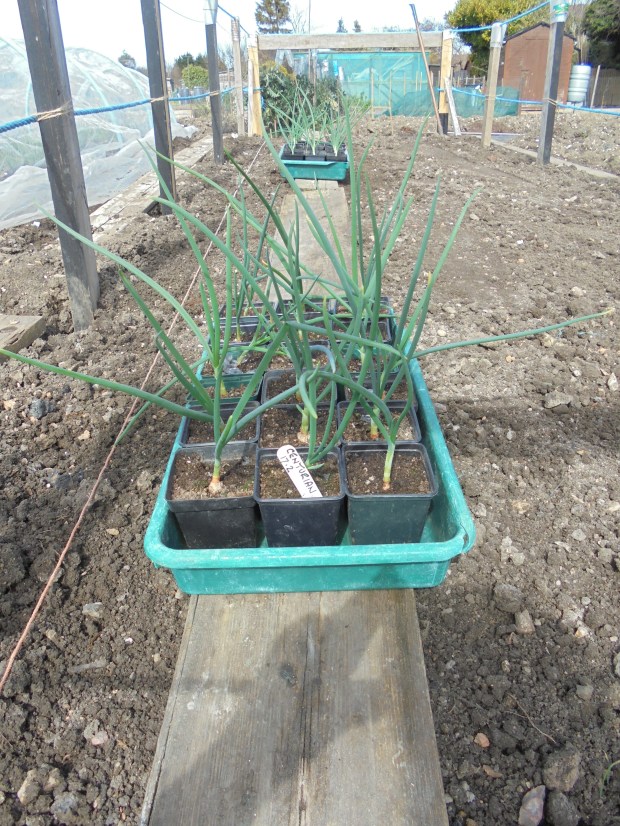
Nowadays I start off my sets early February by planting in 4” pots of good quality multipurpose compost, smaller pots and cell trays are too root restrictive. They are then grown on in the greenhouse and planted out as the soil starts warming about the third week of April and spaced as above. This way up to eight weeks of steady growth and a plant with a large root system and quite a few leaves has been developed in sheltered conditions; ultimately if given space a good-sized onion can be produced.
A third way of starting off onions is by sowing seed. At Ashbrook I have never produced decent onions from seed sown directly in the ground; it might be possible in warmer areas. However, seed sown in January in a half tray, germinated indoors, say on the kitchen window cill, pricked out into 3” pots, grown on in a frost-free greenhouse and planted out during the second half of April and spaced as above can give good results.
The bulbs swell during July and if an onion is needed immediately for the kitchen it can be used straight out of the plot without ripening. However, if they are to keep through the winter, they do need thorough ripening and a well-ventilated greenhouse or cold frame is invaluable for this. If the bulbs get a surge of late rainwater they do not keep well, can develop split skins and be prone to mildew so if wet weather is forecast, I lift them out of the ground quickly. Generally, I lift towards the end of July or early August and lay the bulbs flat or tilted at an angle on a greenhouse shelf protected from rain for about four weeks. When nearly ripe trim the tops and leave upside down to continue ripening for a couple more weeks, they should then be ready for storage. Although many like to string up their onions I have not found this a good method for long term storage. However stored upside down in plastic mesh mushroom boxes (to ensure any residual moisture can drain and evaporate and allow free air movement) kept in a cold but frost free shed they should keep well until the following spring. During the following April as any remaining onions start to come back to life peel off any loose skin and put them in the salad drawer of the fridge. Ours keep this way till the middle of June by which time fresh shallots are available and the next year’s onion crop is not far away. By storing this way, we have not bought any onions for many years.
Onion White Rot is becoming a severe problem around the country particularly on allotments; it is normally initially imported via infected onion and shallot sets then spread via muddy tools and boots, once in the ground it can take at least 20 years to eradicate. With an isolated outbreak any infected bulbs along with a spit of surrounding soil is best bagged up promptly and disposed of away from the site where it will cause no damage. Drenching the hole with Jeyes Fluid seems to prevent it spreading further; infected bulbs should not be put on the compost heap. It is very noticeable that gardeners who retain their own clean shallot sets and who grow their onions from seed therefore not importing any sets whatsoever have the least problem.
In many areas including Ashbrook leek moth and allium leaf miner are causing significant damage.
Leek moth affects mainly leeks, being a moth, the larvae is a small caterpillar, i.e., small legs. The first cycle of eggs is laid in April and hatches and during July and August when a second cycle of eggs is laid, the larvae from which pupate over winter to start the cycle again the following April.
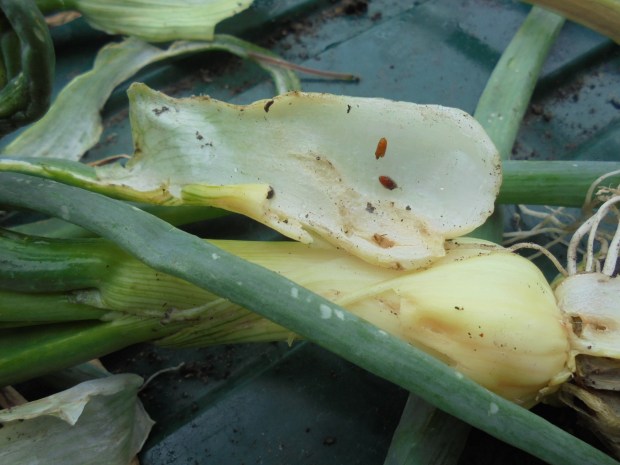
Allium leaf miner is far more destructive as it damages all alliums e.g., onions, leeks, shallots, chives, garlic and ornamentals, being a fly, the larvae is a maggot i.e., no legs. First generation eggs are laid March/April the second October/November, larvae from this second hatching pupate over winter in the soil or in unprotected alliums i.e., leeks, before emerging in the spring to continue the cycle.
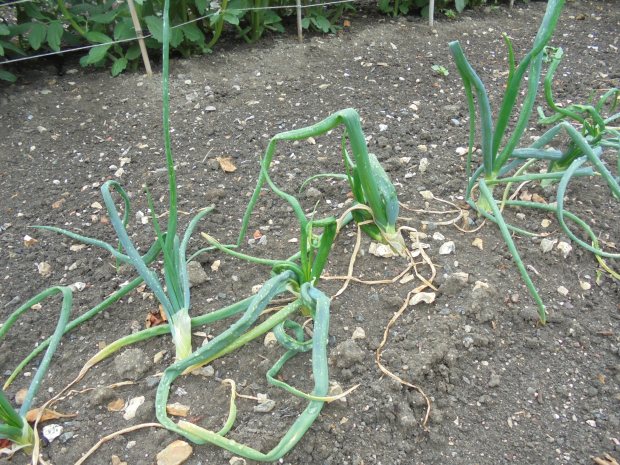
The damage with both pests is similar, leaves have light green spots, appear distorted and the larvae found within the crop cause further damage often leading to botrytis. Plants found with these pests should be properly disposed of away from the site and not left in or on the ground or composted.
There are two ways of growing onions to overcome these pests: –
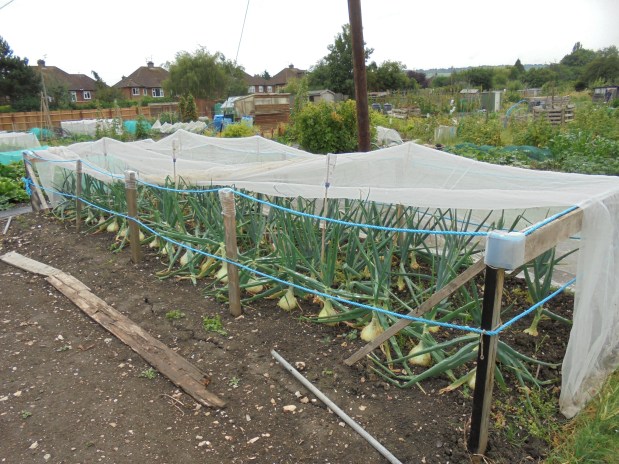
- Cover crops with fine insect mesh supported on timber framework or with plastic or metal hoops. Ensure the mesh has no holes, is closed at the ends and has plenty of slack along the bottom edges to prevent pests entering via uneven ground. When weeding remove the protection only during damp or windy weather when pests are less likely to be on the wing.
- An alternative method without using insect mesh is to use heat treated onion sets, these are can be obtained by mail order from most seed companies but are not normally despatched until late March, it might also be worth enquiring at Aylesbury Trading Hut. These sets grow very quickly and if in early April they are planted into 3” or 4” pots using good compost, can then grown on at home away from the allotment site ideally in a greenhouse or cold frame for about six weeks. Then bring to Ashbrook and plant into prepared ground about mid-May by which time the first generation of allium leaf miner should be gone and your onions will be ready to harvest before the second-generation hatches.
Suggested varieties: –
Sets.
Centurion is a particularly good variety that bulbs early and stores well, my own preference.
Fen Globe, Stuttgater Giant and Sturon also give good results and store well.
Santero, another good keeper with downy mildew resistance.
Red Baron, a very popular red onion but from sets is prone to bolting. If you have this problem either plant sets when the ground starts to warm up say about the third week in April or grow from seed.
Seed
Red Baron
Red Pearl, (from Dobies at Paignton, Devon, not the garden centre) an improved Red Baron F1 onion again suitable for growing from January sown seed.
 Ashbrook Allotments